Planting a tree is one of the best investments you can make in your home. In Austin, though, not every tree will thrive. Our summers are long and hot, droughts are common, and soil ranges from thin limestone in the west to heavy clay in the east. Choosing a tree that fits these conditions saves you water, money and heartache. Here are some of the best trees for Austin yards.
Large Shade Trees
Live Oak
The live oak is the classic Austin shade tree. It is evergreen, long lived and tough in heat and drought. Live oaks grow wide, so give them plenty of room. Because they can get oak wilt, plant them with other species nearby rather than in a solid row.
Cedar Elm
Cedar elm is a native that handles clay, rock, drought and heat. It has small leaves, a nice upright shape and yellow fall color. It is one of the toughest shade trees for Central Texas.
Bur Oak
Bur oak grows into a massive tree with huge leaves and big acorns. It is more resistant to oak wilt than live oaks and red oaks and does well in deeper soils.
Chinquapin Oak
Chinquapin oak handles alkaline soil well and grows faster than many oaks. It is a great choice for limestone areas in West Austin.
Shumard Oak
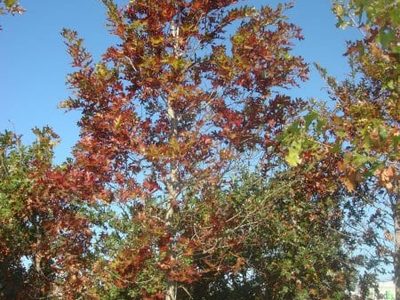
Shumard oak offers beautiful red fall color. It is a red oak, so it is more prone to oak wilt. Plant it where it will not share roots with live oaks.
Mexican White Oak
Also called Monterrey oak, this fast growing oak has a tidy shape and handles drought well.
Medium and Small Trees
- Texas redbud: Bright pink flowers in early spring and heart shaped leaves.
- Mexican plum: White spring blooms and a graceful shape.
- Desert willow: Orchid like summer flowers and great drought tolerance.
- Eve's necklace: A small native with hanging pink flowers.
- Possumhaw holly: Red winter berries that birds love.
- Texas mountain laurel: An evergreen with fragrant purple spring flowers.
Trees for Wet Spots
If your yard has a low area that stays damp, bald cypress is a beautiful choice. It also works near creeks and ponds.
Trees to Avoid
Some trees are popular but cause problems in Austin:
- Arizona ash: Fast growing but short lived and prone to breaking.
- Bradford pear: Weak branches that split in storms.
- Silver maple: Shallow roots and weak wood in our heat.
- Chinese tallow: An invasive species that spreads into natural areas.
- Ligustrum: Another invasive that crowds out native plants.
Tips for Choosing the Right Tree
- Check the mature size: Make sure the tree will fit when it is full grown.
- Look up: Avoid planting large trees under power lines.
- Know your soil: Thin limestone and heavy clay favor different trees.
- Plan the shade: Shade on the west and south walls does the most to cut cooling bills.
- Mix species: A variety of trees protects your yard from one disease or pest.
Matching Trees to Austin Soil
West Austin and the Hill Country have thin soil over limestone, which favors live oak, chinquapin oak, Lacey oak and Texas redbud. East Austin and Round Rock often have deep black clay that cracks in summer, where cedar elm, bur oak and Shumard oak do well. If you are not sure what soil you have, dig a small test hole or ask an arborist to take a look.
When to Plant in Austin
Fall and winter are the best times to plant trees in Austin. Roots get several cool months to settle before the heat returns. Trees planted in late spring or summer need extra water to survive.
Professional Tree Planting in Austin
Austin Complete Tree Service has planted trees across Austin since 1978. Our certified and experienced arborists help you pick the right tree for your space and plant it the right way. Learn more about our tree planting service or see our tree planting gallery.
Tree Selection Questions
What is the fastest growing shade tree for Austin?
Mexican white oak, chinquapin oak and Mexican sycamore grow quickly in Austin. Fast growing trees still need good care to build strong structure.
Are live oaks a good choice with oak wilt around?
Yes, but plant them alongside other species and follow good pruning habits to lower the risk.
What small tree has the best spring flowers?
Texas redbud and Texas mountain laurel both put on a great spring show and handle Austin conditions well.
Related reading: tree roots and your foundation, when to trim hedges in Texas and whether drought stressed trees recover.